Skip to the guide
EXACT 41

Metabolic signalling / EDUCATIONAL GUIDE

MOTS-C

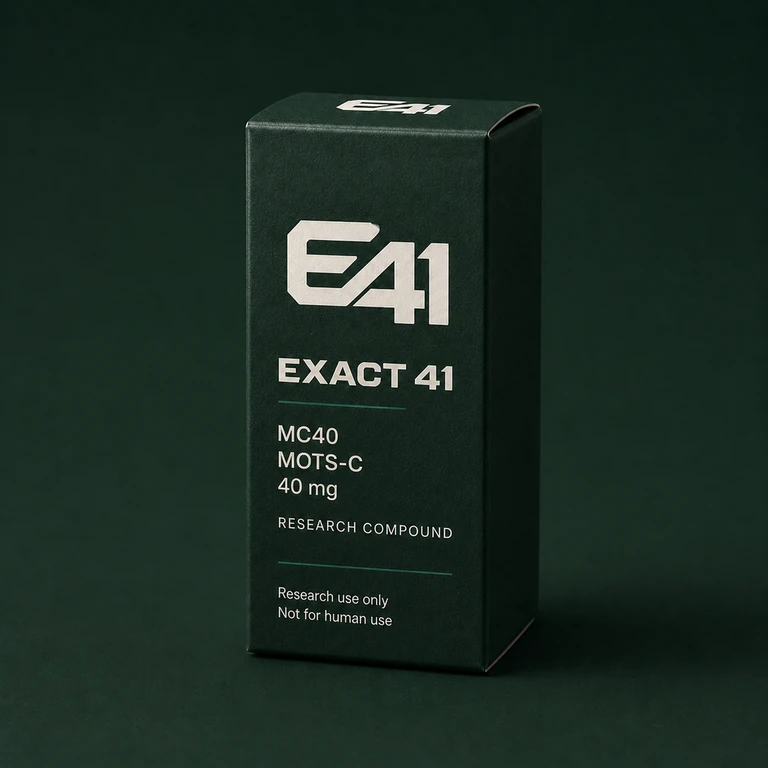
MOTS-C 40 mg box packaging mockup
Packaging mockup
40 mg€74.90

Research aims, observed effects
and the limits of the evidence.

Preclinical evidence focusSources checked 6 September 2026

THE IDEA IN EVERYDAY TERMS

The connection between exercise and energy use

MOTS-C is a small peptide encoded by mitochondrial DNA. Think of it as a signal involved in how cells respond to energy demands. Cell and mouse research links it to AMPK, an energy-sensing system, and to insulin sensitivity—how readily tissues respond to insulin when handling blood sugar.

Read the background ↗

Mouse experiments + human exercise measurements

What has actually been shown?

A 2021 study found that giving MOTS-C to mice improved physical performance. In a separate part of that study, ten young men exercised on a stationary bicycle; their naturally occurring MOTS-C levels rose in muscle and blood. The men were not given MOTS-C. The human measurements therefore do not demonstrate that taking it improves fitness.

Read the evidence ↗

“Exercise in a bottle”—what does that mean?

The phrase is shorthand for interest in exercise-related metabolic signals. It overstates the evidence if read as a promise: the cited study does not show that taking MOTS-C reproduces the benefits of exercise in people. A clearer description is “studied for exercise-related energy signalling and physical performance in mice.” Read the source ↗

What is MOTS-C?

MOTS-c is a 16-amino-acid peptide encoded within mitochondrial DNA. Research explores its role in metabolic regulation. [1]

Why it is studied.

Researchers investigate insulin sensitivity and cellular responses to metabolic stress. The foundational work used cells and mice, rather than a therapeutic trial in people. [1]

Following the research question.

The discovery study links MOTS-c to metabolic pathways and AMPK signalling, a cellular energy-sensing system. This is a research model, not an established treatment pathway in humans. [1]

MOTS-C research map: Mitochondrial peptide; Metabolic signalling; Mouse outcomesRESEARCH MAP / MOTS-C01Mitochondrial peptide02Metabolic signalling03Mouse outcomes
Conceptual research map, not a molecular structure or a proven chain of clinical effects. [1]

What the evidence shows.

The 2015 study reported improved insulin sensitivity and protection against diet-induced metabolic changes in mice. Animal results cannot establish human weight-loss or longevity benefits. [1]

Study context

Cells and mice

Key distinction

Metabolic measurements

Uncertainty

Human benefit unresolved

A selected-source overview, not a systematic review. Research findings are not verified effects of an independently supplied sample.

Risks belong beside the findings.

FDA identifies missing human exposure information and potential immunogenicity concerns. [2]

Human benefit, long-term safety and reliable clinical outcomes remain unresolved in the sources reviewed.

Go to the source.

  1. MOTS-c and metabolic homeostasis ↗

    Cell Metabolism, 2015. Primary preclinical study.

  2. FDA — Safety concerns for certain compounded substances ↗

    Regulatory safety assessment; route and formulation matter.