01 / OVERVIEW
What is GHK-Cu?
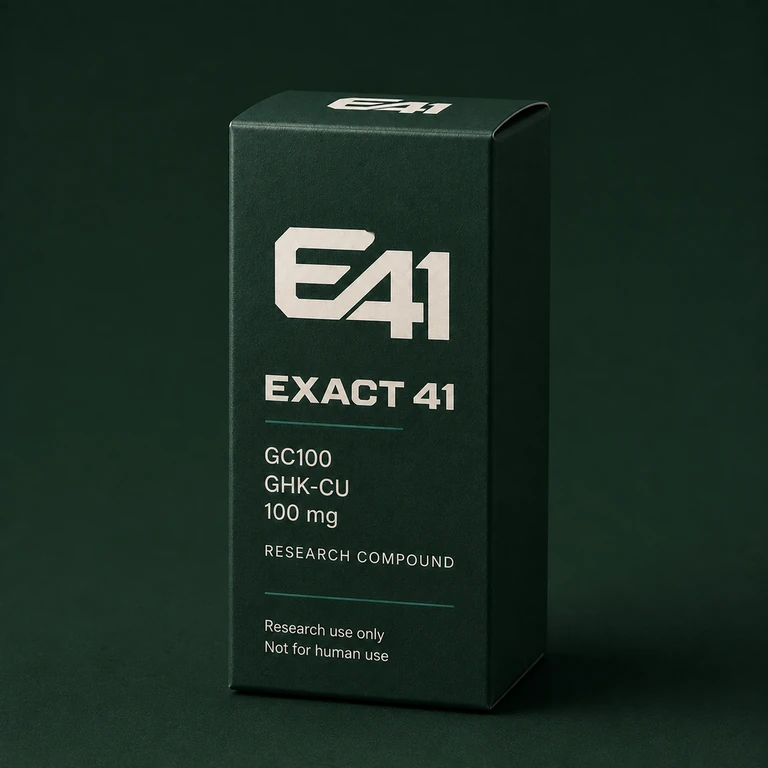
GHK-Cu is a copper complex of the tripeptide glycine-histidine-lysine. It has been investigated in connective-tissue biology. [1]
02 / RESEARCH AIMS
Why it is studied.
Research asks whether it changes extracellular-matrix production during wound repair. The cited experiments used wound chambers in rats. [1]
03 / RESEARCH MAP
Following the research question.
Researchers measured changes in collagen, glycosaminoglycans and associated gene expression. These are tissue-level observations, not proof of systemic rejuvenation. [1]
04 / OBSERVED EFFECTS
What the evidence shows.
The rat study found increased connective-tissue accumulation in the experimental wound chambers. That does not establish healing efficacy in people. [1]
Study context
Animal experiment
Key distinction
Tissue measurements
Uncertainty
Human transfer uncertain
A selected-source overview, not a systematic review. Research findings are not verified effects of an independently supplied sample.
05 / SAFETY AND LIMITATIONS
Risks belong beside the findings.
FDA notes limited human safety data and immunogenicity concerns for injectable GHK-Cu. [2]
Evidence from a local animal model cannot establish the safety or effects of a different formulation or route.
06 / REFERENCES
Go to the source.
- GHK-Cu in rat experimental wounds ↗
Journal of Clinical Investigation, 1993. Primary animal study.
- FDA — Safety concerns for certain compounded substances ↗
Regulatory safety assessment; route and formulation matter.